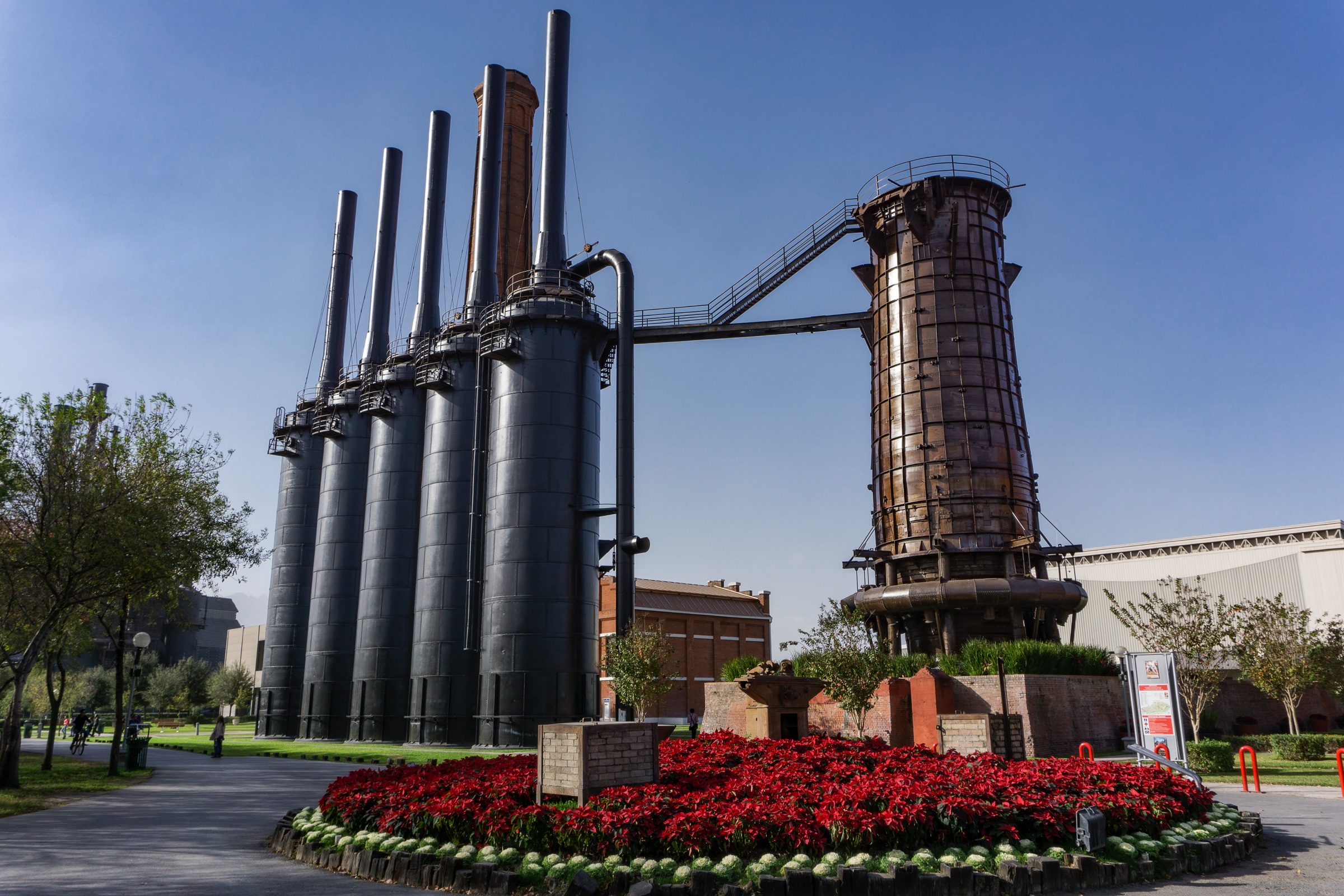
Monterrey did not grow out of conquest, pilgrimage, or empire. It grew up around a steel mill. The Compañía Fundidora de Fierro y Acero de Monterrey opened its first blast furnace in 1900 and ran until 1986 — eighty-six years, at its peak more than ten thousand workers, the largest integrated steel operation in Latin America for several decades. Every other story about how this city became what it is unspools from that fact.
The workers
The honest history begins with the people who actually worked the mill. The foundry hands, the rolling-mill operators, the welders, the machinists, the men who stoked the blast furnaces in twelve-hour shifts under conditions that are difficult to picture today. The women who held the families together — who cooked the lunches that went to the mill in metal carriers, who managed household budgets when the railroads brought migrant labor from San Luis Potosí and Coahuila for the worst shifts. The neighborhoods that grew up around the foundry — Acero, Bella Vista, the original Independencia — were built block by block by these families. Their grandchildren still live in the city.
The mill closed in 1986, and the city absorbed that closure without breaking. Eighty thousand people lost their jobs within five years. The municipal response — converting the entire industrial site into a public park, preserving Horno 3 as a monument, building the Museo del Acero inside the actual blast furnace — is one of the better acts of industrial heritage preservation anywhere in North America.
The four families
The names you see on the institutions — Garza, Sada, Zambrano, Clariond — were the families who capitalized the mill in the first place and who built nearly every business that followed. Eugenio Garza Sada founded FEMSA, which today operates the largest convenience store chain in Latin America (OXXO) and the largest Coca-Cola bottler in the world. Lorenzo Zambrano built Cemex into the global cement company it now is. The Garza Lagueras built Alfa, the petrochemical conglomerate. The Clariond family anchors Cuprum and IMSA.
Beyond business, the founding families built the institutions: the Tec de Monterrey was founded in 1943 by a consortium of the same industrial leadership; the Hospital Muñiz and several major medical centers came from the same circle; the cultural institutions — the Museum of Modern Art (MARCO), the Museum of Mexican History — are largely products of family philanthropy. The four names appear on plaques across the city in a way they do not in any other Mexican metropolis.
This concentration matters because it shaped the political culture. Monterrey developed an unusually direct relationship between the private sector and the city itself — the major employers also funded the universities, the hospitals, and several civic improvements that elsewhere would have been government-led. Some of this is genuine philanthropy; some is corporate governance under a different name. Both readings have evidence.
The labor anchored the city. The families anchored the institutions. Both are true; only one ever made it onto the plaques.
The proximity premium
The single underrated factor in Monterrey’s wealth is geography. It sits one hundred and forty miles from the U.S. border. After NAFTA in 1994 and the maquiladora expansion that followed, Monterrey became the natural distribution and manufacturing hub for the entire northeastern Mexico-U.S. trade corridor. Cemex sells into the U.S. construction market. FEMSA OXXO supplies bordertowns. The major auto-parts and appliance manufacturers cluster in Apodaca and Santa Catarina, all within trucking distance of Laredo.
The estimated value of cross-border trade through Nuevo León is in the high tens of billions of dollars annually. Monterrey captures a substantial share of it because the logistics, the workforce, and the executive infrastructure are already here.
The wealthiest mile
San Pedro Garza García is the residential expression of all of this. Technically its own municipality, with its own police force and development codes, it has the highest per-capita income of any municipality in Mexico and, on most measures, in Latin America. The streets are clean in a way that is uncommon, the dress codes at dinner are closer to Madrid than to Mexico City, and the schools are private and English-bilingual by default.
This is not unique to Monterrey — Mexico City has its equivalent in Polanco and Lomas, Guadalajara has Provincia. What is distinctive about San Pedro is that it is geographically continuous, politically autonomous, and structurally connected to the industrial families who built it. You can walk a single corridor — Calzada del Valle — and see the names of the founders on the parks, schools, and plazas.
The historic core of Monterrey — including the Macroplaza and the Faro del Comercio that anchor it — is mapped at macroplaza.mx. The Alameda Mariano Escobedo, one of the older public parks in the city, is at alamedamonterrey.com.
What the wealth does and does not solve
Worth noting, briefly, what the prosperity has not fixed. Monterrey has a serious water-supply problem (covered separately in our note on the water question). It has air-quality problems in winter from a refinery in Cadereyta. The income inequality between San Pedro and the eastern industrial neighborhoods is wider than the national average. The city is wealthy in aggregate but unevenly so, in the way of most North American metros.
None of this changes the underlying story. The city was built by people. The institutions were built by families. The wealth is real, the labor history is real, and both deserve the credit.